


Research into the motives for investing in websites is an integral part of Ambi’s activities. We share insights. In 2025, the overwhelming majority of B2B players still pursue one goal of online presence — “We exist.” To confirm the fact of the company’s / brand’s existence. That’s it.{{1rem}}
An effective corporate portal solves a set of complex tasks:
- image and trust building
- recruitment of top specialists who share the company’s values
- effective generation of leads >> clients >> revenue
- product improvement through user behavior research and A/B testing
At the same time, for most B2B companies, the website performs the function of an information archive (the same PDF on a domain): it is used by sales managers for quick data search when forming commercial proposals for clients. At best. Because sometimes it does not even cover these needs.{{1rem}}
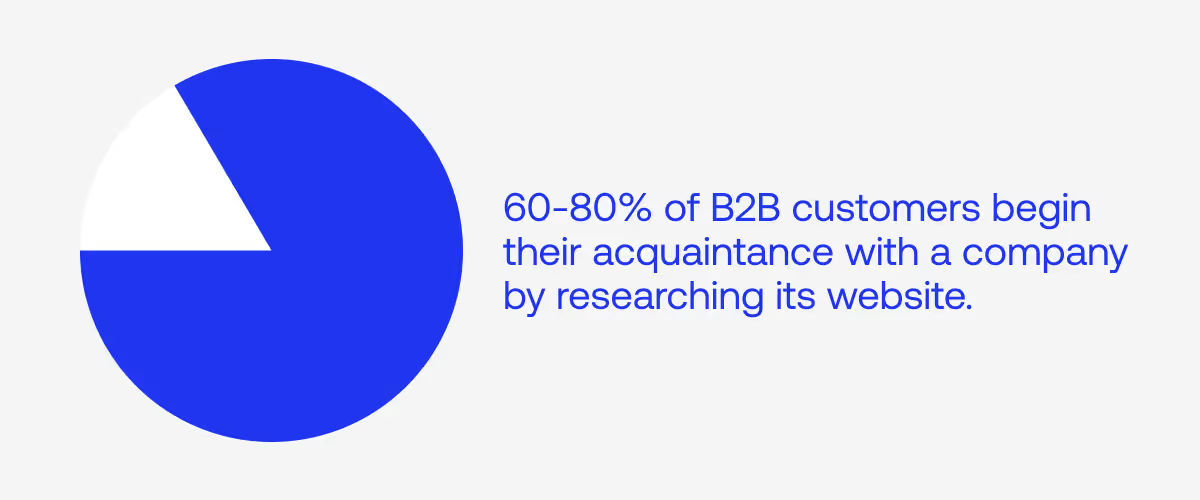
More than 50% of B2B companies use their corporate website as a PDF on a domain. At the same time, 60–80% of B2B clients start their acquaintance with a company by researching its website.
Inertia of thinking and negligence of management regarding online presence lead to competitive defeat, loss of revenue, and gradual transformation of the company into a digital archaic entity that is inevitably pushed out by the market.
Working with progressive industry leaders, we see and implement the best examples of monetizing online presence. But stepping outside the professional Ambi bubble, it turns out that a significant number of companies still have not unlocked the full commercial potential of their corporate websites.{{3rem}}
Anatomy of failure: how your website turns into an “Image Dump”
An “Image Dump” is not just bad design. It is a marketing metaphor for a resource that was created as a “digital business card” but became a monument to lost opportunities. Such a website has negative value: it consumes resources for maintenance while actively repelling clients.
Here are 5 fundamental reasons why a corporate website does not become an asset, and what consequences this leads to:
1. Critically low speed (Performance Failure)
Physical loading speed is the first and toughest barrier. If a page “thinks” for too long, the client simply will not reach your valuable offer.
- Business impact: You lose up to 53% of mobile users before the first click. Every second of waiting directly increases customer acquisition cost (CAC) and decreases conversion. The marketing budget is literally wasted on traffic that never waits for the page to load.{{2rem}}
2. Design that destroys trust (Image & Trust Deficit)
The visual obsolescence of a website is instantly projected by users onto the quality of your product or service.
- Business impact: Loss of reputational capital. Up to 75% of users make a judgment about the reliability of the entire company based solely on the website design. If it looks like a greeting from the 2010s, the level of trust drops, and the potential client goes to a competitor with a more modern “face,” even if your product is objectively better.{{2rem}}
3. Lack of user focus (UX/CX Breakdown)
A website created “for ourselves” or “for the CEO” ignores the real customer journey. When the structure is illogical and information is not organized around the audience’s needs, the resource becomes useless.
- Business impact: The client experiences cognitive overload and irritation. If within 10–20 seconds a person does not understand how you are useful, they close the tab. This leads to a high bounce rate and zero visit effectiveness. You own a tool that no one can use.{{2rem}}
4. Marketing vacuum and lack of conversion (Strategy Gap)
The website exists without being tied to a sales strategy. It is a “PDF on a domain” with lots of text about “dynamic growth,” but without any call to action (CTA) or a clear next step for the client.
- Business impact: Interruption of the customer journey. Since 80% of B2B decisions begin with online research, a website without lead-generation mechanisms simply “drops out” of the sales funnel. This leads to lost profit, because the site does not collect contacts and only passively displays them.{{2rem}}
5. Technological stagnation and technical debt (Technical Debt)
This is a deep-rooted problem: the use of outdated CMSs, complex “crutch-based” solutions, and the absence of updates. This is not about speed, but about the inflexibility of the entire system.
- Business impact: The website becomes a “suitcase without a handle.” Any change, integration, or A/B test launch takes months instead of days and costs several times more than on modern stacks. Technical debt “eats” 15–30% of your IT budget, blocking development and making the company sluggish compared to fast-moving competitors.{{2rem}}
Conclusion: An “Image Dump” cannot be revived with cosmetic fixes. It is a resource that creates a toxic environment for your marketing. If you recognized your website in at least two points, it is time to turn this burden into a real digital asset.
However, we can diagnose the symptoms of transformation at early stages in order to prepare for an inevitable technological crisis.{{3rem}}
.avif)
Symptoms of a website turning into an “Image Dump”:
High “Entry Threshold” for changes (Complexity):
- If even a simple conversion change (for example, changing the text on a CTA button) requires an expensive narrow-profile developer rather than a content manager, changes simply do not get implemented.
Slowed Time-to-Market and loss of flexibility:
- Testing new hypotheses, launching promotions, or creating new lead forms takes weeks instead of days, which leads to a critical loss of relevance and missed profit.
Accumulation of Technical Debt (Technical Debt):
- The use of outdated CMSs or custom-built solutions creates “technical debt” that sooner or later will require huge one-time investments to fix, stopping any further development.{{2rem}}
Lack of a dedicated in-house team / Entropy:
- If website development is handled by whoever is available or by everyone a little (instead of a clearly assigned UX/CRO specialist), the situation inevitably leads to chaos and functional degradation.{{2rem}}
Visual Drift:
- Individual sections of the website (for example, the blog, product pages, forms) have different designs because they were created at different times without unified UI guidelines. This destroys brand integrity and trust.{{2rem}}
“Patchwork” Integration:
- The website has integration problems (for example, with CRM, analytics systems, or subscription forms) or uses too many third-party “crutches” (plugins), which constantly causes bugs and requires manual intervention.{{2rem}}
The good news is that a website is only your digital storefront, not your entire business. It is never too late to realize the true value of a corporate website and start building it from scratch as a key asset.
The main change must happen not in the code, but in the approach: perceive the website not as a budget expense, but as an investment with a concrete ROI. A true digital asset is one that scales together with your business, not one that restrains it.
Your next step? Conduct an honest audit and decide: are you ready to continue maintaining a “dump,” or is it time to build a foundation for growth.


