The recent article by Webflow CEO Linda Tong about restructuring the team is more than just a corporate announcement about layoffs. Yes, formally it's about the fact that some employees are leaving the company. But if you read the text more carefully, something more important stands out: Webflow publicly acknowledges that the web development market is changing dramatically, and the old formula of "build a beautiful site without developers" no longer looks as unique as it did a few years ago.
And this is an important signal not just for Webflow. It's a signal for the entire no-code and low-code market, for agencies, freelancers, marketing teams, and companies that still treat a website as a separate project: built it, launched it, occasionally update it.{{2rem}}
Simple Sites Are Becoming Too Simple
One of the key phrases in the article reads:
"AI tools and lightweight builders are providing a faster path to launch for those with simple website requirements."
This is probably the most honest part of the entire announcement. Webflow is essentially saying: if a client needs a simple site, a landing page, a presentation page, or a basic marketing showcase, the market already offers faster and cheaper ways to do it.
Webflow used to be almost magic. Without classic development, you could assemble a production-ready site with a solid visual system, CMS, responsive design, animations, and a high level of control. For designers, freelancers, agencies, and small businesses, this was a strong offer: "we can build a site faster, cheaper, and without a large dev team."
But now the lower and middle layers of the market are gradually being eaten away by AI tools and lightweight builders: Framer, Wix, Squarespace, Relume, and dozens of new AI-native solutions. Not completely. Webflow is still more powerful, flexible, and deeper than many alternatives. But the pressure is obvious: for simple tasks, clients are increasingly asking not "what's the best tool to build this with?" but "why should this cost a lot and take weeks at all?"
And that changes the rules of the game.{{2rem}}
Webflow No Longer Wants to Be Just a Website Builder
The second important idea: Webflow is clearly shifting its positioning. Historically, the platform was strong for designers, freelancers, agencies, SMBs, and teams that needed a powerful visual builder. In other words, Webflow sold the ability to create sites without the classic development process.
Now the emphasis is different.
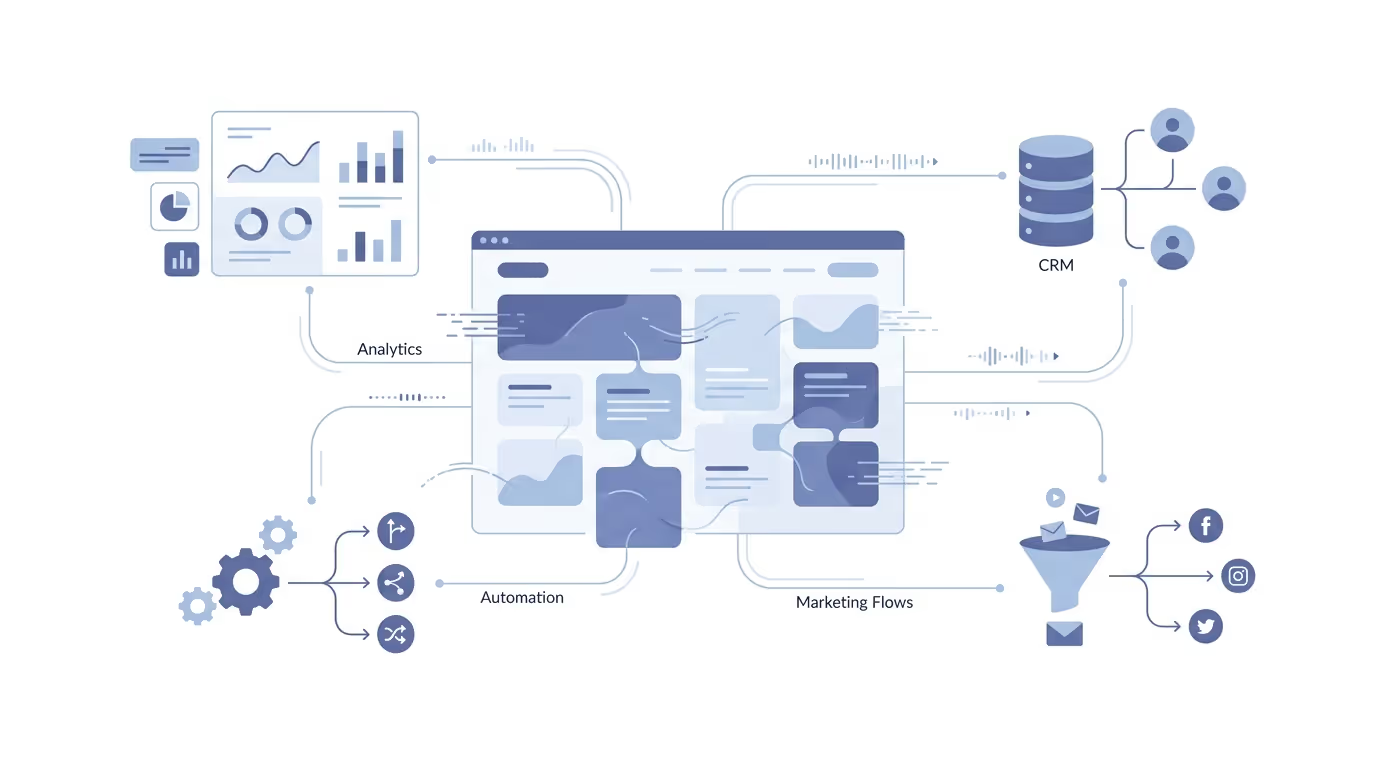
Webflow is no longer talking simply about building sites, but about marketing teams, growth teams, enterprise clients, and companies where the website isn't a business card but a growth channel. Not just "a place with information about the company," but a system connected to the marketing stack, analytics, personalization, A/B tests, customer journeys, and internal business processes.
This is a fundamentally different level of task.
In this approach, the website isn't a final artifact but a constantly working mechanism. It needs to be changed quickly, used to test hypotheses, launch campaigns, adapt to audience segments, and connect to CRM, analytics, automations, advertising stack, content processes, and AI tools.
That's exactly why Webflow uses the phrase "agentic web marketing platform." This is no longer about "assemble a page without code." It's about a platform where a marketing team can build, optimize, and develop web experiences together with AI agents that become part of the workflows.{{2rem}}
Why the Team Had to Change
The second quote from the article explains the logic of the restructuring even more directly:
"We cannot achieve this vision through prioritization alone. We have to change where we invest and change the size and shape of the team."
If you strip away the corporate layer, the meaning is this: it's not enough to simply tell the current company "now we're focusing on AI, enterprise, and the marketing platform." A new strategy requires different investments, different roles, a different structure, a different speed of decision-making, and a different set of competencies.
This is an unpleasant but logical part of the transformation. When a company changes the market it's targeting, it can't leave its old operating model inside unchanged.
If a large part of the value used to be built around the visual builder, design, CMS, templates, the agency community, and the ability to launch sites quickly, then now the center of gravity is shifting toward more complex tasks: AI, personalization, optimization, integrations, enterprise workflows, security, analytics, large-team collaboration, and the speed of marketing experiments.
This doesn't mean Webflow is ceasing to be a tool for designers or agencies. But it does mean that the most important client for Webflow's future is no longer the one who simply needs a beautiful site. The most important client is the team for which the website is directly connected to revenue, pipeline, conversion, and marketing speed.{{2rem}}
What This Means for Agencies and Webflow Specialists
For agencies and specialists, this is a fairly sobering signal. The simple service of "we'll build you a site on Webflow" will be increasingly poorly defended. Not because Webflow is bad. But because the category of "just a site" itself is getting cheaper.
If a client needs a basic landing page, AI and lightweight builders will increasingly create the feeling that it can be done quickly, almost automatically, and without a serious team. Yes, the result will often be mediocre. Yes, there will be problems with structure, scaling, SEO, support, integrations, and real business logic. But for part of the market, this will be enough.
So the value of agencies also has to shift higher.
Not "we make pages," but "we build a growth system around the website." Not "we design layouts in Webflow," but "we help the marketing team launch campaigns faster, test hypotheses, collect data, improve conversion, and connect the website to the rest of the stack."
This is a different conversation with the client. And a different level of responsibility.
It's no longer enough to show the client a beautiful hero section and a few animations. You need to explain how the site will live after release. Who will update it. How quickly the team will be able to launch new pages. What data will be collected. How hypotheses will be tested. How the site connects to CRM, forms, email campaigns, analytics, paid campaigns, automations, and content.{{2rem}}
AI Doesn't Just Replace Part of the Work. It Changes Expectations
It's important not to oversimplify the idea into "AI replaced people." In its article, Webflow isn't talking about that. Their argument is subtler: AI changes the rules for marketing teams and for the entire process of creating digital experiences.
AI accelerates the start. AI lowers the cost of simple tasks. AI creates new expectations around speed. AI makes normal what used to seem expensive: quickly getting a page structure, generating copy, assembling a prototype, preparing variants, adapting content to segments.
But because of this, the value of another part of the work grows: strategy, systematic thinking, integrations, architecture, quality of execution, analytics, and the ability to turn a website into a manageable growth tool.
That's exactly why Webflow says its own marketing team will become one of the first proof points of what a modern marketing organization can look like when AI agents are embedded in daily work.
This is a fairly strong signal. Webflow wants to show not just a new set of AI features. They want to show a new team model: less manual operations, more speed, more ownership, more connection between the website, marketing, and business results.{{2rem}}
The Main Takeaway
Webflow's layoffs are a painful but telling moment. The company publicly acknowledges: the market for simple sites is changing faster than before. AI and lightweight builders make launching a basic site simpler, faster, and cheaper. So Webflow is trying to go where the depth of the product still matters: marketing teams, enterprise, growth, personalization, experiments, integrations, and AI agents.
For the market, this means one thing: simply "knowing how to make sites" is no longer enough.
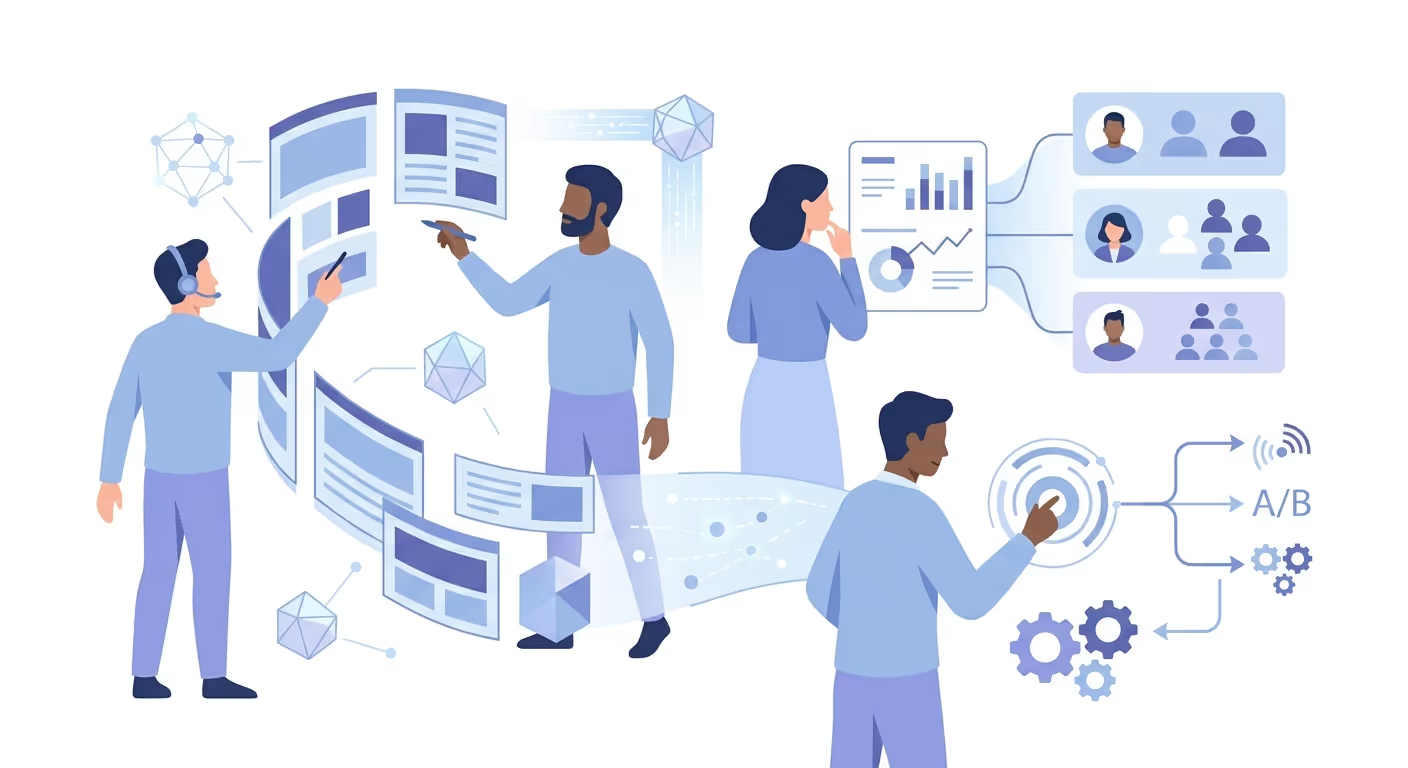
Future value won't lie in who can assemble a page faster. Future value will lie in who can build a system where the website works for the business continuously: launching campaigns, collecting data, testing hypotheses, adapting to audiences, and helping the team move faster.
Webflow seems to be betting on exactly this. And for everyone who works around Webflow, no-code, and marketing sites, this is a good moment to honestly reconsider their positioning.
Because the market isn't disappearing. It's just growing up.
And in a grown-up market, the winner isn't the one who "makes the site." The winner is the one who understands why the site exists and how it should deliver results.