How much does it cost to create a website? It would seem like a simple question. But when you start to understand, you realize: the answer depends on a bunch of factors.
A website has long ceased to be just a pretty picture with contacts. Now it is a working tool – it brings clients, handles their objections, collects requests and, essentially, works for you around the clock.

No one makes websites “just to have one” anymore. Business wants a resource that doesn’t look like it’s from 2010, doesn’t “lag” on the phone, and delivers results. That’s why the price range can be cosmic. Everything depends on the task: do you need a basic business card site quickly, or a powerful platform that will scale together with the business.
In 2025, website development prices vary dramatically – from a few hundred dollars for a simple page to tens of thousands for a complex project with deep functionality. It’s not that developers want to hit the jackpot. It’s about how much needs to be done: design, thinking through the structure, connecting third-party services, setting up analytics, filling it with content.
In this material, we analyze what determines the cost of creating a website, when it is worth investing in serious development, and when you can manage with a simple option – and how to understand how much it will cost in your specific case. We have gathered information about how prices are formed on the Ukrainian market in 2025.{{2rem}}
Why the cost of a website does not have a single price
There is no concept of a standard website in web development. Two companies may order a corporate website, but one of them will be a simple “business card” solution on WordPress for $800, and the other – a complex system with CRM integration, multilingual support, and custom solutions for $10,000.
The reason is the difference in goals. Every client has their own goals. Some need a small business card site – just to present the company, while others want the website to sell, accept orders, collect analytics, and work as part of a large business system. In the first case, you can manage with a website builder or a simple CMS, but in the second, you cannot do without a team of developers, designers, and analysts.
And one more point: the experience of the team directly affects the price. Experienced specialists charge more, but usually their work pays off – because fewer problems arise at the support stage. A cheap website is always a prepayment for future problems.
A website - is not a product but a project. Its price is formed individually, just like the cost of apartment renovation or filming an advertisement. That’s why it’s impossible to answer the request without details.
What affects the cost of creating a website?
The cost of website development is influenced by many factors: structure, design, content filling, number of language versions, number of worked-out breakpoints (desktop, large monitors, tablet, horizontal mobile, vertical), depth of testing, etc. Sometimes it is the small details that can change the budget by hundreds of dollars. The biggest impact is made by the following factors:
- Website type. A one-page landing, a blog, a corporate portal, an online store, or a marketplace – these are completely different levels of complexity. On average, as of 2025, creating a website in Ukraine costs from $800 for a simple landing to $10,000 and higher – if it is a large store or a system with integrations.
- UX/UI design. The visual part of the website has long ceased to be just a beautiful picture. It is a well-thought-out interaction logic, testing user scenarios, adaptation to different devices. Visual forms trust – and often becomes the reason why a person stays or leaves. The cost of website design is not an expense, but an investment in conversion.
- Functionality and technologies. The technological base also affects the budget. Websites can be created on ready-made CMS – WordPress, OpenCart, Shopify – or from scratch on frameworks such as Laravel or Yii2. The first option is cheaper and launches faster, but has limitations in customization. Development on frameworks is more expensive but gives more freedom for the project’s growth in the future. Custom development is more expensive, but flexible and secure.
- Content and SEO. Filling the website with texts, photos, product descriptions, and SEO optimization – this is another 10–30% of the budget.
- Support and scaling. After launch, expenses do not end. Launching a website is only the beginning. Then the normal life of the project begins: plugin updates, technical monitoring, fixing minor issues, adding new features. In most Ukrainian studios such support costs on average from 18 to 35 thousand hryvnias per month.
When you understand these expenses, you can immediately distribute the budget correctly and avoid common pitfalls: not saving on UX, not forgetting about SEO, and not leaving the website without technical support. Because a website is not like buying furniture and forgetting. It is a tool that works for the business only when it is kept in working condition.{{2rem}}
Website type
The website type is the first thing that determines how much a website costs. The goals define how many specialists are needed, which technologies to involve, and what the scope of work will be. For example, a simple landing page for advertising a course or a new product will cost approximately 30–40 thousand hryvnias. But a corporate portal with CRM integration or an online store with thousands of products is a different level: from 150 to 500 thousand and higher. The average prices on the Ukrainian market in 2025 look exactly like this – with a large variation that directly depends on the tasks, scale, and depth of functionality:
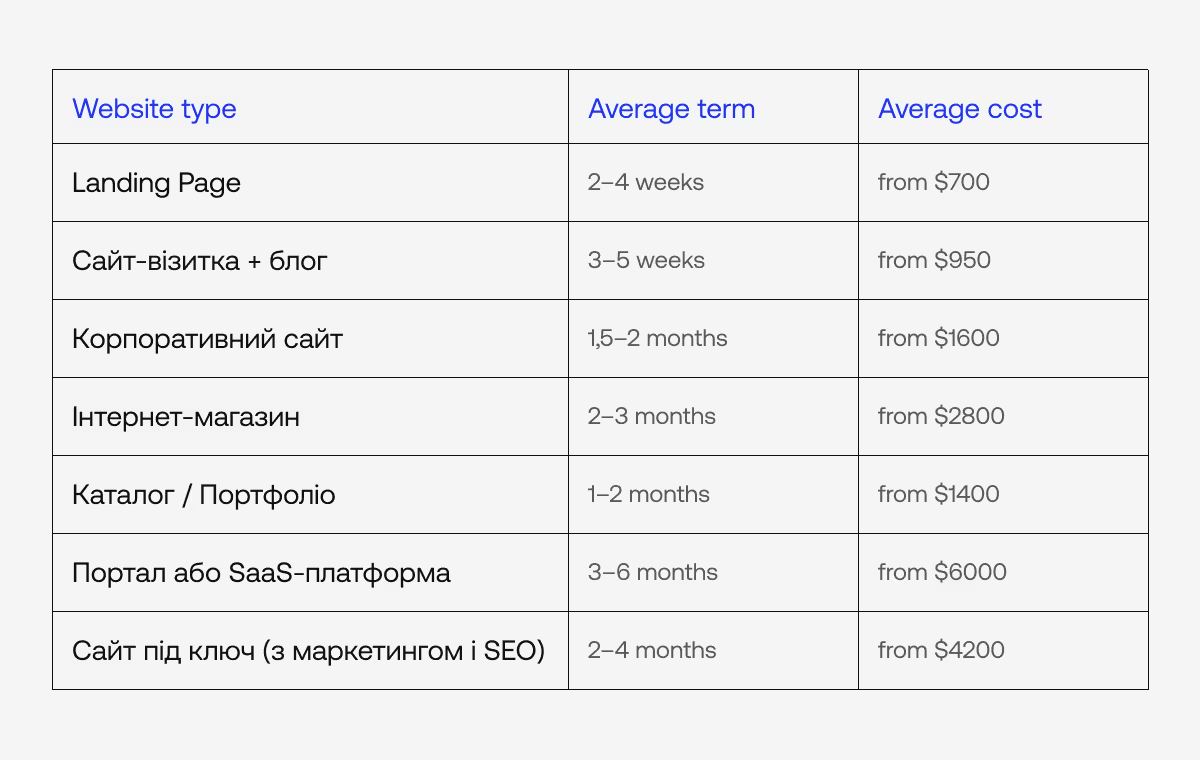
The cost is also influenced by the features you want to implement. For example, multilingual support, a personal user account, a cart, automatic notifications, filters, integration with payment systems or CRM. Each of these points increases the complexity and duration of development.
If you are planning a serious product with growth potential, it is better to allocate a budget for scaling in advance.{{2rem}}
Design: template or unique solution
Design is what a person sees first. And at the same time, one of the most expensive items in the project. Here, customers are usually divided into two types: some want it fast and cheap, others — so that the website is memorable and not similar to others.
Even if you take a ready-made template, it must look modern. But more and more often, businesses are moving toward individual solutions — to stand out among competitors.
A template is essentially a ready-made foundation where you simply insert your content. Suitable for small projects or startups that are just testing an idea. It costs from 20–30 thousand hryvnias, and can be launched in a couple of weeks.
But if the business is counting on serious traffic and plans to work on the market for a long time — the template becomes too limited. Unique design takes into account how people behave on the site, what they need, how the niche works. It is not just a beautiful picture — it is a tool that builds trust and influences whether the person will buy or not.
Individual design starts at around 60 thousand and can reach 200+ for large commercial projects. The more complex the product, the more time is spent on prototypes, testing, and layout approvals.
Design today is not just an expense. It is an investment in how a person feels on your website. And this already determines whether they stay or leave.{{2rem}}
Technologies and CMS: WordPress, Bitrix, custom development
Another important factor that determines how much it costs to create a website is the technologies on which the site is built:
- WordPress – the most popular CMS in the world. Suitable for small websites, blogs, corporate pages. The main advantages are launch speed and affordable website development price (approximately from 30–50 thousand UAH). But when scaling, limitations may arise: a large number of plugins and complex logic affect performance.
- Bitrix24 / 1C-Bitrix – a solution for medium and large businesses, especially when integration with CRM or ERP is needed. It costs more (from 100 thousand UAH), but the system is stable, secure, and withstands heavy loads.
- Custom development on frameworks (Laravel, Yii2, Django) – an option for companies that think ahead. There are no templates here, but there is full flexibility, speed, and security. The cost starts from 200 thousand UAH, but the result is a unique product independent of third-party platforms.
The chosen technologies determine not only costs but also the durability of the website. If a simple start is needed, CMS constructors are suitable. But if you plan to develop the project and scale, you should choose frameworks that do not limit growth.{{2rem}}
Functionality and additional integrations
Each additional feature is a new line in the budget. Online chat, interactive map, calculator, shopping cart, filters, widgets, synchronization with 1C, Telegram bot, or connecting artificial intelligence – all this increases the cost of website development.
Integrations are what hit the budget the most. Need to attach a payment system, connect the site with your CRM, or integrate an external service via API? Be prepared that the cost will increase by 30–50%, or even more.
The more complex the functionality, the more expensive and longer it will take. Development timelines also heavily depend on complexity. A landing page can be launched in about a month, while an online store with filters, personal account, online payments, and integrations is already 2–3 months minimum.
It is the functionality that determines how user-friendly the site will be and how effective it will be for the business. By investing in it, you are essentially investing in future sales and customer loyalty.{{2rem}}
UX/UI design as a cost factor
The UX/UI design stage can account for up to 40% of the entire budget. In 2025, it is not just a set of layouts, but a combination of psychology, analytics, and testing. UX (User Experience) shows how a user navigates the site, whether it is easy for them to find what they need, and whether it is comfortable to place an order. Good UX means fewer drop-offs, more sales.
UI (User Interface) is the visual language of the brand: colors, fonts, icons, styles. It is through UI that trust in the company is formed—from the first seconds of the visit.
A professional approach to UX/UI involves audience research, creation of prototypes, testing different options, and adaptation for all types of devices. Because of this, the cost can range from 50,000 to 250,000 UAH—depending on the scale and complexity of the project.
UX/UI is not a one-time process. A site is a living organism. It has to be constantly adjusted to people, because what seemed convenient yesterday may already be annoying today. They look at statistics, analyze how users move through the page, where they stop, where they leave. And each small improvement then returns as profit: people stay longer, buy more often, the brand becomes memorable.{{2rem}}
Experience and level of the developer / studio
Another criterion that affects the price of a website is the team. When the question arises—whom to go to, a freelancer or a studio—it all comes down not only to money. Everyone has their own style and approach.
- A freelancer can do it quickly and cheaply, starting from about 20 thousand hryvnias. But the risks are also on you: if something breaks, you will have to look for someone to fix it.
- Small studios work more stably—they have a team, and each person is responsible for their part. Prices range from 50–150 thousand hryvnias.
- Digital agencies already play in a higher league: analytics, design, marketing, SEO—all under one roof. Of course, they start from 200 thousand, but the result is predictable.
As in any field, you pay for the contractor’s experience. But reliability and quality of implementation allow you to avoid expenses for reworking, failures, and loss of positions in search results.{{2rem}}
Main stages of website creation and their cost
To understand where the price comes from, it is worth breaking the process down into steps. A website is not made in one day – it is dozens of small decisions that together form the final result. That is why two websites that look similar may differ in price several times. Usually, the process is divided into several main stages.{{2rem}}
Analytics and planning
First, the team, together with the client, figures out why the website is needed at all, who will use it, what pages should be included. They write the technical assignment, draw the structure, think through the scenarios. Without this, everything else is pointless.
For such a preparatory stage, they usually charge from 300 to 1,500 dollars – depending on how deeply they dig.{{2rem}}
UI/UX design
UI/UX design is already the creative part. Here the appearance is born: colors, fonts, spacing, buttons. The design should not only please the eye but also lead a person to take action.
Template options cost approximately 400–800 dollars, and a fully individual approach – from 1,500 and higher.{{2rem}}
Layout and programming
This is the technical part, where the design turns into a working website. Then everything comes to life. They connect CMS – WordPress, OpenCart, Webflow. They add integrations, adaptation for phones. The price ranges from one thousand to five thousand dollars, depending on complexity.{{2rem}}
Testing and launch
Testing and launch – the final touch. They check that everything works, nothing freezes, pages open quickly.
They optimize for search, connect analytics, place the website on a server. This stage usually costs 200–700 dollars, but it shows whether the website is ready for real visitors.{{2rem}}
Content filling
After launching the technical part, the website needs content – texts, photos, videos, graphics. It is the content that forms trust in the company and determines how understandable and attractive the website will be for users.
On average, the cost of filling content ranges from $200 to $1500, depending on the volume of pages and quality requirements. The work includes preparing SEO-optimized texts, selecting images, layout of materials, and formatting checks. If it is an online store, uploading products, photos, characteristics, descriptions is added – then the budget can reach $2000–3000.{{2rem}}
Support and updates
And even after launch, the work does not end. The website needs to be updated, the speed checked, and errors corrected. Otherwise, it gradually “dies.” Basic support costs 100–300 dollars per month, full technical maintenance – from 700. Large projects usually sign a one-year contract with a fixed number of hours.
Each stage of website creation – from analytics to technical support – has its own price, and all of them form the final budget. In some cases, speed is important, in others – a personalized approach or SEO optimization. Therefore, the cost of creating a website is always formed individually. But the more thoroughly each step is worked out, the more stable the resource will operate and the faster it will begin to generate profit.{{2rem}}
Additional expenses that are often not considered
When customers ask what the price is to create a website, most forget about mandatory related expenses. These are the items without which the website will either not launch or will not function correctly.
- Domain and hosting. Registering a domain name costs 10–30 $ per year, hosting – from 50 $ to 300 $, depending on the type and load of the website.
- SSL certificate. Secure connection, mandatory for any modern resource. Price – 15–100 $ per year.
- Paid plugins, themes, integrations. For CMS WordPress or OpenCart, it may be dozens of additional modules – from 50 $ to 500 $ per set.
- Licensed photos and fonts. High-quality visuals are not free; images cost from 5 $ per unit.
- SEO and advertising. For promotion, you will also need from 300 $ per month for SEO work or Google Ads.
It is also worth considering updates and redesign every 2–3 years. This is not a designer’s whim but a necessity – technologies, trends, and user behavior change, and the website must remain relevant. If all these details are taken into account at the start, the final budget will not come as a surprise, and the website itself will be an investment that works, not just an expense.{{2rem}}
*Price depending on the type of website
The cost depends not only on the approach or technologies but also on the type of website you plan to create. Formats differ in structure depth, design, integrations, and goals — and therefore in price. Below are the benchmarks for the main types of websites in 2025.{{2rem}}
Landing Page
A landing page is a single-page resource for one purpose: to sell, collect applications, or present. Its strength lies in speed and visual presentation.
The simplest option is a single-page website on a ready-made builder. It can really be assembled in a few days and fit within 500–800 dollars. But if you need custom design, texts, analytics, tests, and integrations — the budget starts from 1500–3000 dollars.
The price is influenced by the number of screens, the presence of animations, 3D effects, integrations with CRM or payment systems. However, a good landing page is not about “beautiful.” It must clearly lead a person to action: show benefits, remove doubts, and push them to click the “Buy” button.{{2rem}}
Corporate website
This is already the business card of a company in the digital world. Here you tell who you are, what you do, what services you have, projects, team, clients. Such a website must be convenient, stylish, and useful.
The simplest version — with basic design and a few pages — will cost from 2,000 dollars. If we are talking about a modern portal with unique design, CRM integration, several languages, analytics and a blog — then the price can reach 4,000–9,000 dollars.
The cost depends on the number of page templates, architecture complexity, and level of design. Corporate websites are often created “for the future,” so it is important to foresee the possibility of scaling.{{2rem}}
Online store
An online store is already a complex tool. It must not only look good but work flawlessly. Everything matters here: catalog, filters, cart, payment, analytics, integrations with accounting or CRM.
If you use a ready-made CMS (WordPress, OpenCart, Shopify), you can fit within 2,500–4,000 dollars. But when custom design, deep filtering logic, automatic inventory updates, or personal recommendations are required — the amount easily increases to 7,000–15,000 dollars and above.
High-load e-commerce platforms with custom backend, CRM synchronization, and mobile adaptation — these are projects with a “starting at 20,000 dollars” price tag.
The main rule: an online store must not just exist — but sell. Therefore, SEO structure, speed, and usability should be considered from the start.{{2rem}}
Portal or complex online system
Portals, aggregators, educational or SaaS platforms — these are already complex digital products. Here, it’s not just about “drawing pages,” but designing a system: user roles, analytics, databases, API, stable servers.
Such solutions are calculated individually, but even basic versions start from 10,000–15,000 dollars, and large corporate projects can exceed 50,000.
Here, the value lies not in design but in architecture — so that the system works quickly, without failures, and can scale with the business.{{2rem}}
Blog, informational or niche website
Such projects are created for content — news, reviews, expert materials, or thematic publications. The main goal is convenience of reading, fast loading, proper SEO structure, and the ability to independently add materials.
A template-based blog on WordPress can be implemented for 800–1200 $. For information portals with many sections, categories, search, filters, and multilingual capability, the cost rises to 3,000–7,000 $.
If it is a niche media project with custom design and deep integrations — the price starts from 10,000 $.
The type of website determines not only its functionality but also the development approach. A landing page can be made in two weeks, while a corporate portal or e-commerce system requires months. Therefore, when you find out how much it costs to create a website — the correct question sounds different: what kind of website do you need and what task should it solve.{{2rem}}
How much does a turnkey website cost?
Ordering a website “turnkey” is the most convenient format for a business that wants to get a finished result without diving into technical details. This approach means that the developer takes over the entire process — from analytics to launch and support. However, this is where confusion often arises: what exactly is included in the service, why prices differ several times, and how to understand whether you are overpaying.{{2rem}}
What is included in the “turnkey” service
The “turnkey” format includes a full cycle of website creation. It is not only programming, as clients often assume, but a whole system of work:
- Analytics and technical specification. Study of the niche, competitors, definition of the website goals, creation of the structure and requirements.
- UI/UX design. Development of the visual concept, responsive layout, prototypes and animations.
- Programming and layout. Implementation of the design on the selected CMS or framework, configuration of integrations.
- Content and SEO preparation. Optimization of pages, writing texts, uploading media, setting up analytics.
- Testing and launch. Checking speed, responsiveness, security, transferring to domain and hosting.
- Support. Basic assistance after delivery: correction of minor errors, plugin updates, consultations.
So the client receives a website ready for use, which can be immediately utilized in business without additional expenses.
The price depends on the type of resource, the scope of functions and the level of the studio, but the main advantage is that after completion you have a fully autonomous product with accesses, documentation and a clear structure.{{2rem}}
What you receive for different budgets
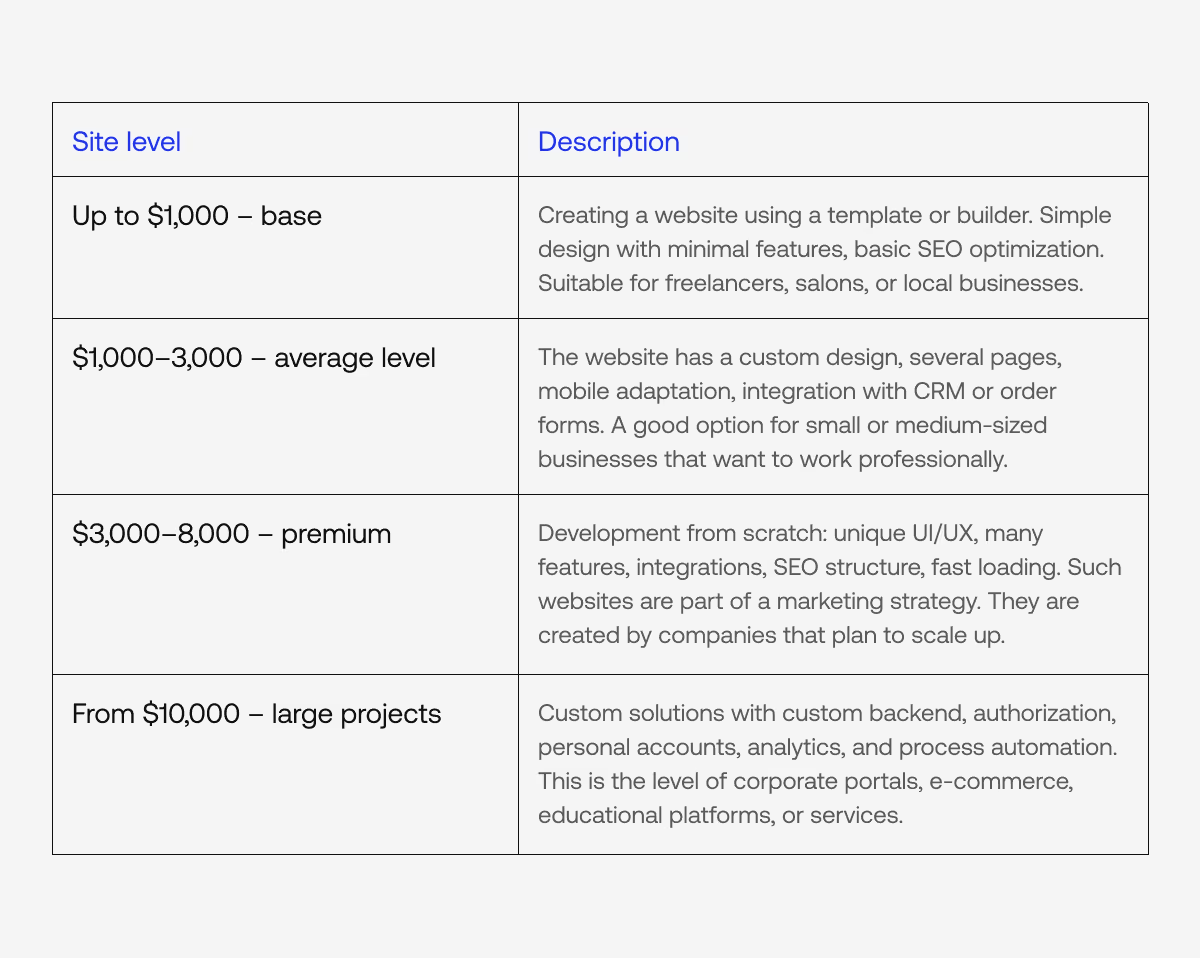
In general, the cost of creating a turnkey website in 2025 ranges from $1500 to $15,000 and more. But the difference between these figures is not just for design or pages. It is the difference between a resource that simply exists and a platform that truly works, sells, and returns the invested funds.{{2rem}}
Cost of websites in Ukraine and worldwide
In 2025, the cost of creating a website varies significantly depending on the region. The main reason is the cost of a specialist’s working hour and the approach to the process. The Ukrainian market remains one of the most flexible and competitive in Europe: here you can get high quality for a reasonable price. On average, website development in Ukraine costs:
- landing page – from $700 to $2000;
- corporate website – from $2000 to $6000;
- online store – from $4000 to $10,000;
- complex system or portal – from $10,000 and above.
or comparison, in the USA and Canada, prices start at $5000 even for a simple website and easily exceed $50,000 for large projects. In Western Europe, the average developer rate is $50–120 per hour, whereas in Ukraine it is $20–50.
This explains why foreign companies actively cooperate with Ukrainian studios: with the same quality, you can save up to 60% of the budget. In addition, Ukrainian developers have a strong technical base, a modern design approach, and a deep understanding of business processes.{{2rem}}
Trends in web development 2025 and their impact on prices
The market is not standing still, and what was relevant two years ago now already looks outdated. Here is what changes the rules of the game in 2025:
- Artificial intelligence. AI already writes texts, analyzes user behavior, and selects personalized offers. On the one hand, it simplifies part of the work. On the other hand, to integrate and configure all this, additional competencies are required.
- No-code and low-code builders. They have indeed made simple business-card websites cheaper. But if you are a serious company that wants to control code, security, and scaling — you will have to order custom development.
- Speed and mobile. Google has long penalized slow websites in search results. Core Web Vitals, adaptation for all screens, instant loading — this is no longer an option but a must-have. Therefore, a separate budget is now allocated for testing and optimization.
- Animations and 3D. Websites are becoming more dynamic — with micro-animations, volumetric elements, and interactivity. It looks cool, but every such effect is additional hours of work for a designer and developer.
- Integration. Businesses want the website not to be a separate island, but the control center: CRM, ERP, email newsletters, analytics — everything in one place. It is convenient, but technically complex.
Websites are becoming smarter and more functional. This automatically means that the average price of development is increasing.{{2rem}}
Conclusions
The price of a website in 2025 is not just design + layout. It is analytics, technologies, team experience, and an understanding of how your business works. In Ukraine, you can order a proper website for $1500–5000. Abroad, for the same functionality they will ask for $10–20 thousand. But more expensive does not always mean better. The main thing is to find those who really understand what you need, and not just stamp websites based on a template.
Websites are becoming smarter, faster, and more convenient. Automation simplifies part of the processes, but without a proper strategy and a team that knows what they are doing, you won’t get far.
A website - is not about “spent money and forgot.” It is an investment that, with the right approach, works for years, brings clients, and generates money. In fact, this is the most honest answer to the question of how much it costs to create a website.

FAQ
What is the minimum price of a website in Ukraine?
In 2025, there are options from $400–800. These are simple landing pages or templates — solutions for a freelancer, a small studio, or a local business. However, even the simplest website requires expenses for a domain, hosting, SSL certificate, and basic SEO. Therefore, a functional project costs from $1000–1500.{{1rem}}
How long does it take to create a website?
The timeline depends on the type of resource, complexity, and the number of specialists involved. Landing page or business card website – 1–3 weeks. Corporate website – 1–2 months. Online store or portal – 2–6 months or more. The difference is explained by the number of approvals, testing, and content preparation.{{1rem}}
What is the difference between a website built on a constructor and a custom one?
A website on a constructor (Tilda, Wix, Webflow) is a quick and budget solution if you need to test an idea or create a simple page without complex functionality. A custom website is built “from scratch”: unique design, flexible code, full control of the structure. It is easier to optimize for search, integrate with CRM or payment systems, develop further.{{1rem}}
Can you make a website yourself for free?
Yes, on constructors with a free plan. But you will get a site with limitations: domain like yourbrand.tilda.ws, banners, minimal functions, and no SEO. Free solutions work for learning or a portfolio, but not for business. So if the goal is real clients, you will need to invest in at least a basic plan, domain, and technical support.{{1rem}}
Why is the price of a website lower in Ukraine than in Europe or the USA?
The main reason is the difference in the cost of working hours. Ukrainian developers charge an average of $20–50/hour. In Europe, it’s $60–120, and in the US — around $150. At the same time, our specialists really “hold the bar”: they know modern technologies, understand global design standards, and work according to the same methodologies as top studios from Europe or America.