Either it stands still. Or it burns. There is almost no third option.
In fast-growing teams, a website is not a “marketing asset”. It is an operational tool: landing pages for campaigns, offers, cases, content, SEO structure, experiments. And if this tool belongs to no one, it starts slowing down GTM.

What a “no-one’s” website looks like
The symptoms are usually very recognizable:
- any change goes through 3–6 approvals
- a landing/page is built for weeks because “let’s polish it a little more”
- marketing is afraid to touch the website because “it will take long again”
- content exists, but SEO does not scale because of chaos in the structure
- redesign becomes “therapy”, not systematic work
And most often this is mistakenly explained as a “developer problem” or “marketing writes poor briefs”. In reality the reason is simpler and more unpleasant: ownership is absent.
When “everyone is responsible” — in fact no one is responsible. Therefore decisions are slow, priorities jump, quality drops, and the website becomes a bottleneck.{{2rem}}
Minimal ownership model that actually works
You don’t need “processes for the sake of processes”. You need three things:
- 1 owner (Accountable) — a person who makes final decisions about the website.
- backlog as a system (not a “queue of fixes”).
- release routine — a regular release rhythm (not “don’t touch it” / “urgent yesterday”).
The owner does not have to do everything by hand. Their job is to keep focus and make decisions.

RACI: how to remove collective responsibility
The simplest way to fix “who does what” is the RACI matrix:
- R — Responsible: performs the work hands-on
- A — Accountable: makes the final decision and carries responsibility (owner)
- C — Consulted: gives expertise but does not turn everything into “endless approvals”
- I — Informed: receives an update, without participating in the decision
The key rule: each area must have one “A”.
If there are two “A” — you will get slowdowns and conflicts.{{2rem}}
Website areas that must have an owner
Here is where without “A” chaos almost certainly begins:
- releases and priorities (backlog)
- campaign landing pages / pages
- content / publishing (CMS workflow)
- SEO structure (taxonomy, internal links)
- analytics (events, conversions, UTM)
- forms/leads (CRM routing, integrations)
- design system / components
- tech debt / performance{{2rem}}
Example RACI for one task (no theory)
Task: launch a campaign landing page with a “Request demo” form + conversion tracking.
- A (owner): Head of Growth / CMO — final “yes/no”, priority, deadline, responsibility for campaign result
- R: Webflow developer + Designer — assemble the landing page, connect the form, make responsive, prepare for release
- C: Brand/Design lead, SEO/Content, Sales lead, RevOps/CRM owner — provide input, but do not become “approvers”
- I: CEO/Founders, Performance marketing, Support/CS — receive update after release and on results{{1rem}}
Three rules so the website stops burning
- 1 A per area
- C — not approval (consultation = advice, not “signature”)
- I — without participation (information = update, not discussion){{2rem}}
Backlog: either a development system, or an endless queue of noise
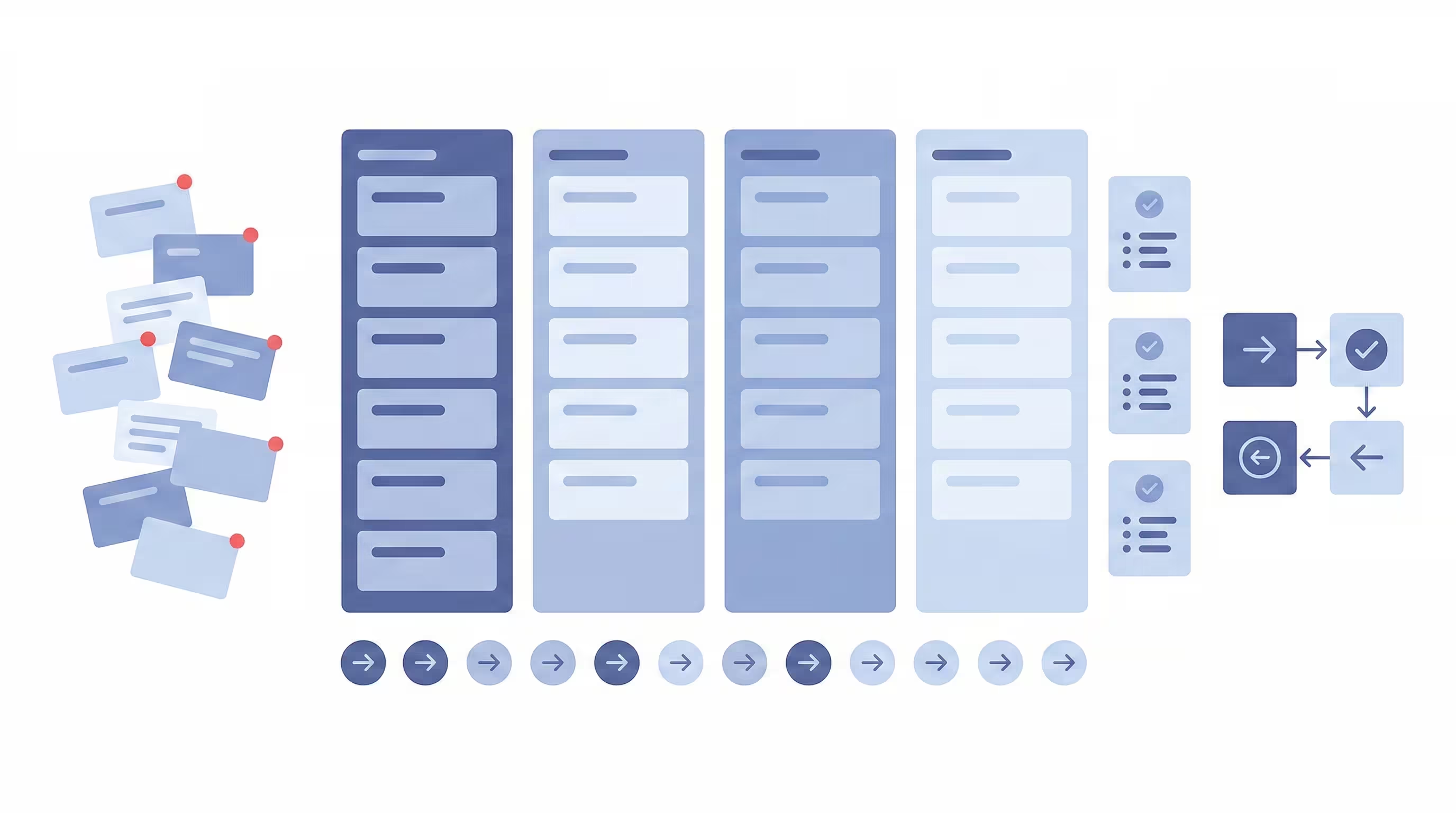
Most teams call backlog a “list of fixes”. That is why backlog does not work.
Typical pseudo-backlog: “fix spacing”, “make it prettier”, “add block”, “urgent”. The result is chaos and absence of progress.
A normal backlog must answer two questions:
- what do we do next?
- why exactly this? (what impact/goal){{2rem}}
Minimal backlog structure: 4 buckets
To avoid mixing everything together:
- Growth (campaigns, landing pages, offer)
- Content ops (publishing speed, CMS)
- SEO (structure, hubs, internal links)
- Reliability (performance, tech debt, stability){{2rem}}
Formula of a proper task
Without a goal/metric, a task should not go to release. The form is simple:
hypothesis → change → metric
Examples (to feel the difference):
- cases will increase trust → add “cases” block on service page → metric: submit rate
- template will speed up page publishing → template for industry page → metric: publishing time + SEO traffic
- standard CTA will reduce errors → 1 CTA component → metric: time for fixes + bugs{{2rem}}
Prioritization without holy wars
Basic rule: “urgent” does not mean “important”.
Minimum filters: Impact / Effort / Dependencies.
And a strict clarification: if there is no impact — the task has no right to be “urgent”.{{2rem}}
Release routine: without release rhythm the website lives in two modes
A website without release routine exists like this:
- either “don’t touch it, it works”
- or “urgent, yesterday”.
And both modes look like “we are busy”. In reality it is just the absence of rhythm.
Release routine — не бюрократія. Це мінімальна домовленість, яка повертає контроль:
- 1 release slot once a week or once every 2 weeks (same day)
- 3–7 tasks per release, everything else — backlog
- 10-minute QA: mobile, links/404, forms (and where the lead goes), key events, basic performance
- no hotfixes in prod — no “tweaking on live”
- rollback plan: what we do if something breaks (the answer must exist before release, not after)
For growth this is critical, because growth is not “brilliant ideas”. It is iteration speed: regular releases = more tests, faster learning, fewer “fires”.{{2rem}}
What to do already this week (minimum that gives effect)
- Assign 1 website owner (A) — a specific person, not a “team”.
- Draw a RACI for 8 areas (releases, landing pages, content, SEO, analytics, forms/CRM, design system, performance) and fix “A” for each.
- Rebuild backlog into 4 buckets and disable tasks without a metric.
- Launch release routine: one release day, 3–7 tasks, short QA, no hotfix culture.{{2rem}}
Summary and conclusion
A website becomes a problem not because of “Webflow/devs/marketing”.
It becomes a problem when there is no owner, which means there is no one to hold decisions, priorities and rhythm.
The conclusion is simple: a managed website = owner + backlog + release routine.
Everything else is either decoration or a way to postpone the unpleasant truth that no responsible person was appointed.